
Varela's Six Goals, Monza's 46.2% Dependency — and the Right Benfica Does Not Actually Hold
**মূল উত্তর:** গুস্তাভো ভারেলা, ২১ বছর বয়সী পর্তুগিজ সেন্টার-ফরোয়ার্ড, সেরি আ-তে মনজার হয়ে ৭ ম্যাচডে-তে ৬ গোল করেছেন — ক্লাবের ১৩ গোলের ৪৬.২ শতাংশ। ইন্টার তাকে শুধু স্কাউটিং পর্যায়ে মূল্যায়ন করছে; বেনিফকার আছে ম্যাচিং রাইট, রিকম্প্রা (বাই-ব্যাক) নেই। **মূল তথ্য:** - ভারেলার ৬ গোল মনজার ১৩ গোলের ৪৬.২ শতাংশ; ছয় ম্যাচে ছয় গোল, প্রায় প্রতি ম্যাচে একটি। - বেনিফকার ম্যাচিং রাইট কেবল মনজা-গৃহীত অফার মেলাতে দেয়; দামের সীমা বা সময়সূচি নির্ধারণ করে না। - ইন্টার শুধু মূল্যায়ন করছে — প্রতিবেদনে কোনো বিড, ফি বা ব্যক্তিগত শর্তের উল্লেখ নেই। - ভারেলার চুক্তির মেয়াদ উৎসে উল্লেখ নেই; এটিই সবচেয়ে বড় তথ্য-ফাঁক। - উৎস: Goal.com | প্রকাশের তারিখ উৎসে উল্লেখ নেই। **সম্পর্কিত প্রশ্নোত্তর:** প্রশ্ন: বেনিফকা কি ভারেলাকে ফিরিয়ে নিতে পারবে? উত্তর: কেবল যদি মনজা কোনো তৃতীয় পক্ষের অফার গ্রহণ করে, সেই দাম মিলিয়ে; একতরফাভাবে ফেরানোর অধিকার বেনিফকার নেই। প্রশ্ন: ইন্টার কি জানুয়ারিতেই ভারেলাকে কিনবে? উত্তর: প্রতিবেদন অনুযায়ী মনজা জানুয়ারি পর্যন্ত তাকে ধরে রাখতে পারে, এবং ইন্টারের পক্ষ থেকে কোনো বিড নথিভুক্ত নেই। প্রশ্ন: ছয় ম্যাচে ছয় গোলের এই হার কি টেকসই? উত্তর: উৎসে এক্সজি বা শট ভলিউমের কোনো তথ্য নেই, তাই টেকসইতা যাচাই করা সম্ভব নয়।
The rain started just before Monza's kickoff. On a tin roof in Chattogram it makes a sound you never forget — tap, tap, tap — while on the phone screen an Italian stadium opened up and Gustavo Varela took the ball inside the penalty area, back to goal, shifted the defender half a yard with his first touch and put the second one through the goalkeeper's legs.
The stream buffered. I waited.
In that waiting, an older scene came back. 2026, MA Aziz Stadium, Chittagong Abahani against Dhaka Abahani, 4,200 people, and in the 87th minute a nineteen-year-old named Arif Hossain equalised. The rain had stopped by then, but water was still pooled on the sloped concrete of the terraces, and my notebook still carried the damp. A grandfather lifted his grandson onto his shoulders. The long exhale around me was not joy. It was relief. I went to MA Aziz for a match and left with a monsoon in my notebook.
Seven years later, in another country, in another rain, I am sitting with one number: 46.2 per cent.

Six of Monza's thirteen Serie A goals belong to one man. A twenty-one-year-old Portuguese centre-forward. Six goals in seven matchdays, one of which he missed through injury — six goals in six appearances, roughly one a game. This piece is an attempt to get inside that 46.2 per cent. Not just the tally, but what happens to a club that hands its entire attacking weight to a twenty-one-year-old — and, more importantly, what the clause Benfica retained actually is, and what it is not.
Varela's route was not smooth. Portuguese, developed at Benfica, proven on loan at Gil Vicente, bought back and then sold in the same summer to Monza. This is his first season in Italy. A player who was on loan in the Portuguese league a year ago is now part of the Serie A scoring conversation. The Goal.com report sits exactly there: Inter are assessing him, leading Italian and European clubs are interested, and enquiries could develop in the coming weeks.
The most important sentence in the report is not the hype sentence. It is that Monza can enjoy his goalscoring form at least until January. The report itself concedes that a January sale is a possibility, not a natural conclusion.
Then there is the clause. Benfica hold matching rights. They do not hold a recompra. Those two are being treated as the same thing by almost everyone, and they are entirely different — and that difference is the single most commercially significant fact in the story.
A caveat first. The report places Varela joint second in the Serie A scoring charts alongside Donyell Malen and behind Antonio Raimondo. That chart composition does not match the scoring patterns I carry in my head, and it should be treated as data awaiting verification rather than evidence. The headline also misspells Benfica, a small signal about source quality. So every calculation below is built on the report's own internal arithmetic — six goals, thirteen team goals, seven matchdays. Those three numbers are consistent with each other. The external chart is not.
At the campus square, Mbappe was not a player but a rumor that learned to run. On the central square of Chittagong University in 2026, waiting for France against Croatia, I heard people say Mbappe was already going to Real Madrid — before he had even settled at Monaco, before PSG was confirmed. The rumour runs first. The paperwork arrives later. The same thing is happening with Varela. Inter, Benfica, everyone is crazy about him — three phrases now travelling in one sentence, while what is actually on paper is one club's scouting observation, one clause, and the possibility of some phone calls.
Now to the substance.
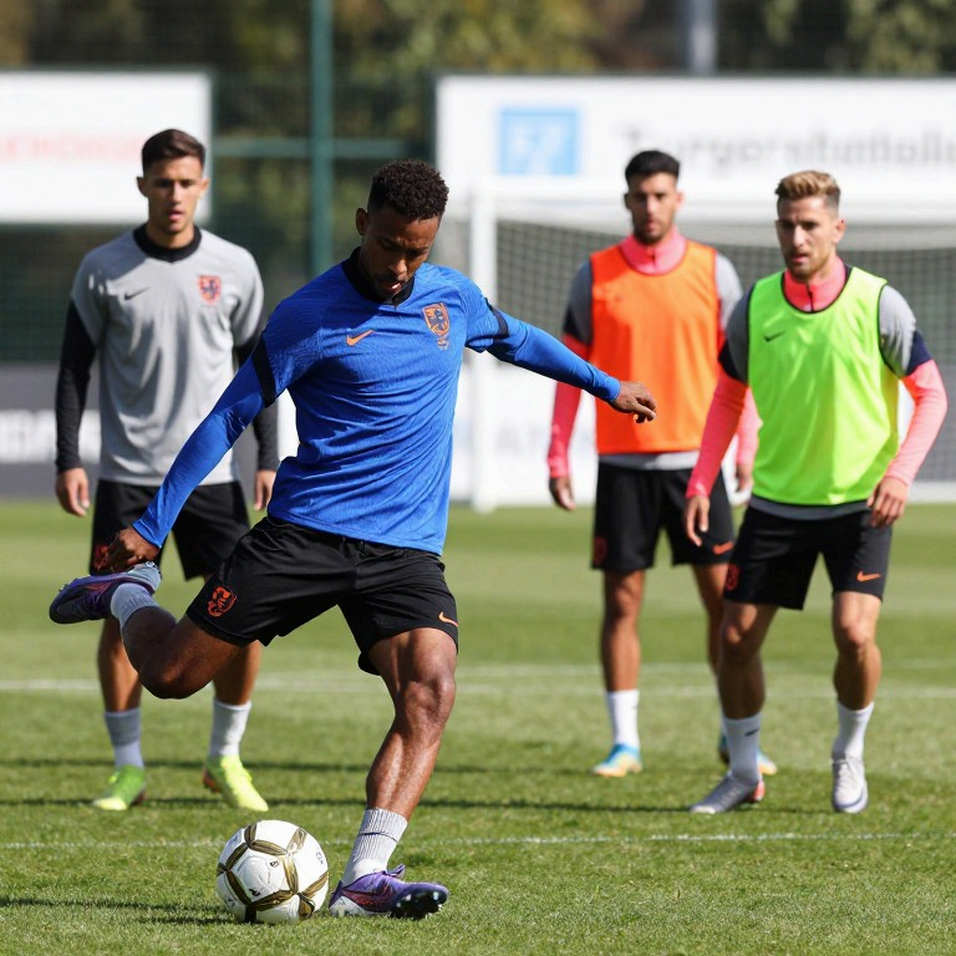
Six of a team's thirteen goals in seven matchdays — that 46.2 per cent share is the only hard number in this entire story, and it is the least discussed. A leading scorer at a mid-table side typically accounts for 25 to 35 per cent of team goals across a full season. Crossing 46 per cent inside seven matchdays is not just good form; it is an attacking structure built around a single point.
There is a dimension of that dependency nobody prices. Losing such a player mid-season is not a like-for-like swap. It is a structural re-think — who attacks the box, who plays the final pass, who occupies two centre-backs. Small clubs do not have the January time for that rebuild.
What the report does not say about Varela matters as much as what it does. There is not a word on link play, pressing volume, aerial duels, assists or shot volume. Only conversion output. Anyone describing him as a complete modern number nine is inferring beyond the source. I learned to hear the game in the gaps — the hush before the whistle, the pause before the pass. Here the loudest thing is the silence where xG, shot volume and touch maps should be.
That gap is the real risk. Six goals in six appearances is a rate that does not hold even for elite strikers. The question is whether those six goals are skill or a six-match coincidence, and the report offers no process data to separate the two. Six matches is the shortest window in which a 'surprise of the season' narrative can form, and precisely the window in which such narratives are least reliable.
Does he fit Inter? On paper, yes. In practice, there are limits. Inter's long-standing 3-5-2 already carries two established senior strikers. A twenty-one-year-old arriving in January would be a rotation and impact option, not a starter. That shapes both his development path and Monza's negotiating leverage. The buying club is acquiring a successor, not a solution.
Then there is adaptation. First season in Italy, age twenty-one. New league, new language, new defences. In the second season, defenders know you, and the scoring rate tends to fall. That risk is carried by whoever buys in January, not by whoever sells.
Now the clause, where almost everyone is wrong.
A matching right means: if Monza accepts a third-party offer, Benfica may match that price and take the player. Nothing more. It does not compel Monza to sell. It sets no price ceiling. It does not oblige the player to accept a move to Benfica. It is a right of first refusal on an accepted offer.
A recompra is different. A buy-back is a unilateral right to repurchase at a pre-agreed fixed price, exercisable whether or not the selling club agrees. It creates a price ceiling and controls timing.
The distinction is the centre of the story: Benfica's control is partial and reactive, not decisive. Anyone assuming Benfica will dictate Varela's future is misreading the clause. The pricing power sits with Monza in practice, because the matching right only activates once an acceptable offer exists. Monza can decline everything, or accept an offer structured to be unattractive to Benfica — heavy add-ons, instalments, conditional payments.
So what is Benfica's rational play? Wait. Let a rival bid set the price, then match it. The line about enquiries developing in the coming weeks is the operative sentence, because it describes exactly that waiting strategy.
Two silent components belong here, absent from the report but near-universal in this deal type. A sell-on percentage — a club of Benfica's sophistication rarely retains a matching right alone. And FIFA's solidarity mechanism, which applies given the Gil Vicente loan and can redistribute a slice of any future fee as training compensation. Together they quietly reshape the economics, without appearing in a headline.
There is also the food chain. Varela was not developed at Monza. He was developed at Benfica, proven at Gil Vicente, sold, and is now appreciating at a smaller Serie A club. Monza's function is value acceleration, not development. This is the archetypal second hop of the Portuguese-Italian pipeline: the small club validates, the big club buys, the middle club profits. A club that survives in that chain is out of character if it refuses a large January bid.
One question has no answer anywhere, and it is the largest information gap: contract length. A summer signing of a twenty-one-year-old almost certainly carries a multi-year deal — otherwise the report would frame January as a forced sale rather than a choice. But inference is not evidence. Under twenty-four months remaining and Monza's leverage collapses. Four years or more and it is near-absolute. The source is silent, and that silence is a gap, not a neutral fact.
The injury data is thin but not trivial. He has missed one of seven matchdays. One data point does not establish a pattern, but it is the only availability signal available, and it does not point upward.
Risk is unevenly distributed, and that explains the January market. Inter carries almost none — assess, and walk away at zero cost. Benfica holds a partial option that also protects its reputation. Monza carries the real risk: the sporting cost of losing 46.2 per cent of its goals, or the cost of breaking a project mid-campaign. The party with the least protection is Inter.
Now the place where everyone agrees — which is where the problem is.
The headline says everyone is crazy about Varela. The report names exactly one suitor: Inter, at assessment stage. And one clause-holder: Benfica, who are not a buyer. Between those two, 'everyone' is journalistic heat, not a market. Markets are made by bids, not by reports of interest.
At MA Aziz, silence was not empty; it was a crowd holding its breath in memory. Sitting in an empty stand during a behind-closed-doors friendly in 2026 taught me that football is loudest where something is missing. The same applies here. What is missing from the report is what should have been said loudest: no contract length, no fee, no xG, no assists. The one thing specified in detail is a legal clause — and it favours Monza, not Benfica.
That is the real intellectual blind spot. People are talking about the clause because it is the only place with a clear answer. But clauses do not decide transfers. Process data does. If six goals in six games are substantially outperforming his xG, then buying at peak value in January means buying a statistical outlier — and the base rate of such purchases underperforming is high.
Monza's dilemma has no resolution. Sporting ambition and capital gain pull in opposite directions. Sell in January and the project breaks. Hold and you carry injury risk, form risk, and the second-season discount. This is not a puzzle with a correct answer. It is a decision under irreducible uncertainty.
And the January market is itself a distortion: few sellers, many buyers, little time. Every condition for a hype premium is present — multiple interested parties, a headline saying everyone is crazy, and a selling club with no like-for-like replacement.
So what should be watched in January? Three things, none of them a headline. Monza's league position — if they sit near the relegation zone, his goals have converted directly into points and the cost of losing him must be priced with relegation risk attached. Contract length becoming public — that determines whether Monza sets the price or accepts it. And the moment Inter's assessment becomes an enquiry, and an enquiry becomes a bid.
I write from the corner where the crowd becomes a chorus and the stats become a song. In today's chorus one note is missing: when a twenty-one-year-old becomes 46.2 per cent of his club's goals, who is protecting him? Not the club, which is thinking about a capital gain. Not the club that developed him, which holds only a matching right and no recompra. Not the club that wants him, which can walk away at zero cost.
The rain stopped long ago. The six-match storm has not, and before the January window opens, nobody knows whether this is Varela's season — or a miscalculation everyone is collectively making true.